
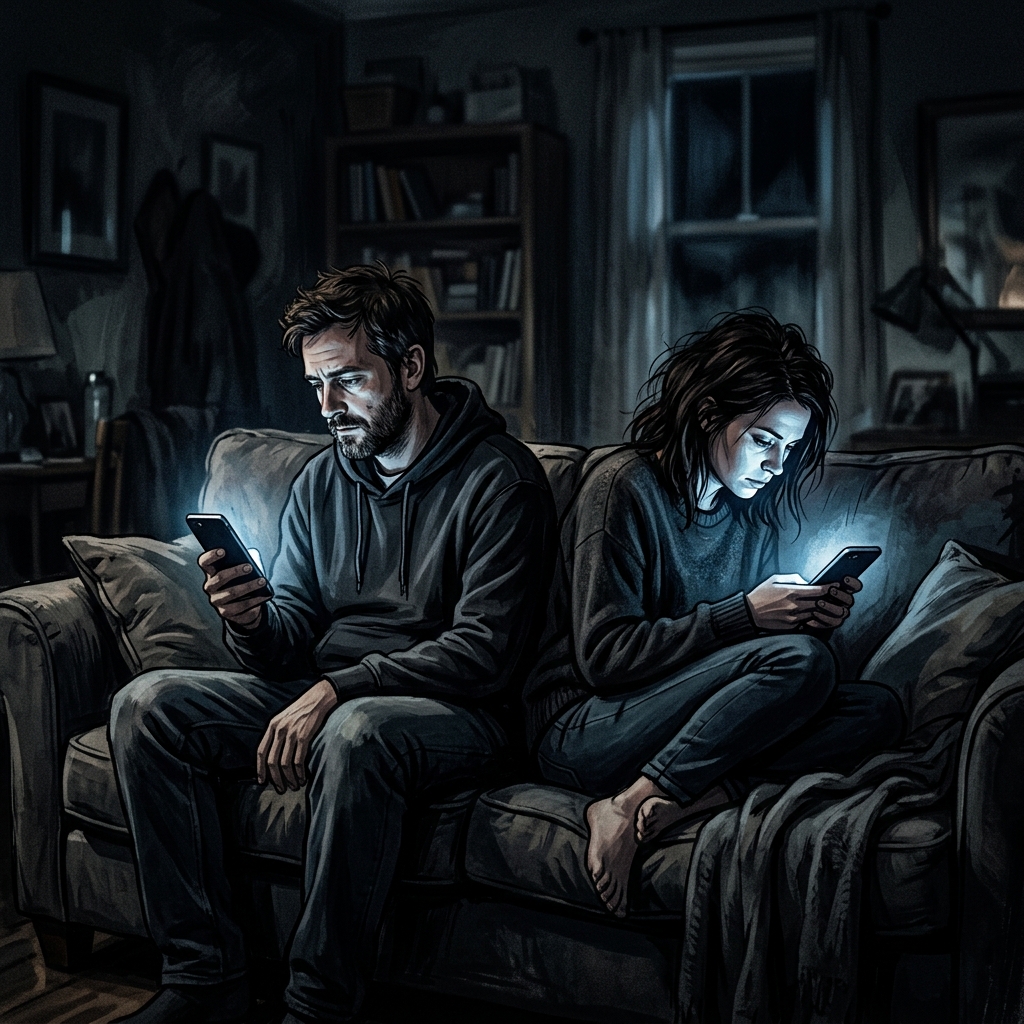
Marriage has always required two people to protect something the outside world cannot protect for them: a private bond built through attention, trust, honesty, sacrifice, affection, and thousands of ordinary moments of presence. Social media did not invent jealousy, infidelity, vanity, secrecy, comparison, resentment, or loneliness. Those forces are as old as marriage itself. What social media has done is place them inside a portable, personalized, continuously operating system designed to capture attention and encourage repeated engagement.
That distinction matters. It would be inaccurate to claim that every person who uses Instagram, Facebook, TikTok, Snapchat, or another platform will damage a marriage. Couples can use social media to share photographs, stay connected with distant relatives, support each other publicly, discover useful information, and communicate across distance. Nor does existing research prove that social media alone causes divorce. Marriages are complex, and much of the research is correlational: dissatisfied people may retreat into their phones, while phone use may also deepen their dissatisfaction.
But rejecting an exaggerated claim should not blind us to the much stronger and better-supported one. Social media creates an unusually hazardous environment for marriage because it industrializes temptation, distraction, comparison, surveillance, and validation. It brings former partners, attractive strangers, private messaging, idealized relationships, and infinite entertainment into the marital home. It then makes these competing stimuli available during dinner, in bed, on vacation, during conflict, and even in the middle of conversations between spouses.
The danger is not merely the content on a screen. It is the repeated displacement of the spouse by the screen – and the emotional meaning that displacement acquires over time. A marriage rarely collapses because of one ignored conversation, one flirtatious message, or one comparison with somebody else’s life. It weakens through accumulation. Social media is exceptionally effective at producing that accumulation.
The top dangers to married couples are these: it steals attention and presence; displaces intimacy; creates pathways to emotional and sexual infidelity; generates jealousy and surveillance; normalizes secrecy; exposes couples to distorted comparisons; converts private conflict into public performance; rewards outside validation; intensifies avoidance and poor communication; and turns family time into fragmented, parallel consumption.
Each danger is serious by itself. Together, they can form a self-reinforcing system that gradually changes how spouses see one another and what they expect from marriage.
1. It steals the attention on which intimacy depends
Attention is not a decorative feature of love. It is one of love’s primary behaviors. When one spouse talks and the other listens, remembers, responds, and notices emotion, the listener communicates: You matter. Your inner life is important to me. When the listener repeatedly glances at a phone, the opposite message can be received even if it was never consciously intended.
Researchers use the term “partner phubbing” to describe ignoring a romantic partner in favor of a phone or digital device. A 2025 meta-analysis synthesized 52 studies representing 58 samples and 19,698 participants. It found that partner phubbing was negatively associated with relationship satisfaction, marital satisfaction, intimacy, responsiveness, emotional closeness, and overall relationship quality, while being associated with more conflict and jealousy. Media addiction was the strongest correlate among the antecedents studied (Ni et al., 2025).
This is damaging precisely because the interruptions appear trivial. A spouse may reasonably think, “I only looked for a few seconds.” But marriage is experienced from the other side of the table. The relevant question is not merely how long the phone was checked; it is how often one partner’s bids for attention were interrupted, postponed, or answered without emotional engagement.
The platforms make this problem worse by eliminating natural stopping points. A newspaper ends. A television episode ends. An infinite feed does not. Notifications, autoplay, algorithmic recommendations, variable rewards, comments, and likes continually invite “one more” interaction. The spouse is therefore competing not with a single activity but with a system that learns which stimuli are most difficult for the user to resist.
2. It displaces the small moments that sustain emotional and sexual intimacy
Strong marriages are not sustained only by anniversaries, vacations, declarations of love, or sex. They are sustained by ordinary contact: talking before sleep, laughing over something insignificant, lingering after dinner, noticing a facial expression, asking a second question, touching without an agenda, and sharing silence without fleeing from it.
Social media consumes precisely these unstructured spaces. It fills the minutes in which closeness might otherwise emerge. Two spouses can spend an entire evening on the same couch while psychologically inhabiting different worlds. They are physically together but relationally absent.
Research on “technoference” – everyday technological interruptions in couple interactions – has found a pathway from greater interference to more conflict over technology and then to lower relationship satisfaction and poorer personal well-being (McDaniel and Coyne, 2016). Daily research has similarly linked technology interruptions and partner phubbing with relationship satisfaction and, through that relationship pathway, emotional well-being (McDaniel et al., 2020).
Sexual intimacy can also be affected indirectly. Desire often depends on emotional attention, privacy, novelty within the relationship, and the feeling of being chosen. Endless exposure to sexualized images, idealized bodies, pornography-adjacent content, and apparently available alternatives can redirect desire outward while increasing dissatisfaction inward. Even without explicit sexual content, bedtime scrolling can replace conversation, touch, sleep, and opportunities for sex. The effect may not be a dramatic rejection. It may simply be that both people become tired and the moment repeatedly disappears.
3. It creates low-friction pathways to emotional and sexual infidelity
Before social media, reconnecting with a former lover or cultivating a new admirer usually required more effort, greater visibility, and a higher probability of discovery. Today, a person can locate an ex, exchange photographs, react to stories, move into direct messages, delete a conversation, and sustain an emotionally intimate connection without leaving the house.
Most affairs do not begin with a formal declaration that someone intends to betray a spouse. They develop through incremental permissions: following someone attractive, enjoying repeated reactions, confiding about marital frustrations, deleting a message to avoid conflict, sharing a photograph intended to invite admiration, or maintaining a “friendship” whose emotional energy would plainly trouble the spouse if the roles were reversed.
Social media is dangerous because it makes every step feel smaller than the pattern it creates. Each message can appear defensible in isolation while the relationship as a whole becomes secretive, emotionally charged, and disloyal. Research examining social-media infidelity-related behaviors has linked those behaviors with relationship dynamics and highlights that online conduct can cross boundaries even without physical contact (McDaniel et al., 2017; Abbasi, 2021).
Emotional infidelity is especially easy to minimize because people confuse the absence of sex with the absence of betrayal. But a marriage can be injured when attention, vulnerability, excitement, reassurance, and private disclosure that properly belong inside the partnership are repeatedly invested in someone else. A useful test is reciprocity: Would the behavior seem harmless if the spouse were doing the same thing with an attractive alternative? Another is transparency: Would the messages be sent in the same language if the spouse were reading them in real time? If the answer is no, the label “friendship” does not settle the issue.
4. It manufactures jealousy, ambiguity, and electronic surveillance
Social media presents spouses with an endless stream of ambiguous evidence: a new follower, a heart reaction, an old photograph liked at midnight, a disappearing message, an unfamiliar name, a hidden friends list, or an attractive person who appears repeatedly in recommendations. Most of these signals do not prove misconduct. That is precisely why they can be psychologically corrosive. Ambiguity invites interpretation, and anxious interpretation invites checking.
Pew Research Center found that 23 percent of partnered adults whose partner used social media had felt jealous or uncertain because of the partner’s interactions with other people on those platforms. The figure rose to 34 percent among adults ages 18 to 29. Pew also found that 53 percent of social-media users had used the platforms to check on a former romantic partner; even among married users, the figure was 45 percent (Pew Research Center, 2020).
A two-year longitudinal study of 322 young adults found that social-media jealousy was associated with more electronic partner surveillance and lower relationship satisfaction one year later (Métellus et al., 2025). This helps reveal a destructive loop. Suspicion motivates surveillance. Surveillance uncovers more ambiguous information. That information generates more questions, defensiveness, and concealment. Concealment then appears to justify the original suspicion.
Unlimited access to a spouse’s phone does not necessarily solve the problem. Forced transparency can become control, while secret inspection violates privacy and trust. Healthy transparency must be mutually agreed upon and accompanied by clear boundaries. Otherwise, the marriage becomes a digital police state in which one person investigates and the other learns to hide.
5. It normalizes secrecy through private, disappearing, and deletable communication
Secrecy is not identical to privacy. Married people remain individuals and are entitled to private thoughts, friendships, and conversations. Secrecy begins when information is deliberately concealed because disclosure would expose conduct that violates an understood boundary.
Platform design makes secrecy effortless. Conversations can be muted, archived, password-protected, moved to alternate accounts, or set to disappear. Activity can occur late at night or during the workday and leave little physical evidence. The user can maintain a public identity that looks entirely devoted to the marriage while conducting a private emotional life invisible to the spouse.
The psychological shift is important. Once a person deletes messages, lies by omission, changes a contact name, or selectively tells a spouse only what can be safely admitted, the problem is no longer merely social-media use. The person is rehearsing deception. Repeated deception changes the deceiver as well as the deceived: it requires compartmentalization, self-justification, and a revised story in which the spouse’s reasonable discomfort becomes the supposed problem.
Trust is difficult to rebuild because discovery does not reveal only the hidden content. It makes every previous reassurance questionable. The injured spouse is left asking not only “What happened?” but “What else do I not know?” Social media’s architecture cannot create dishonesty in a principled person, but it lowers the effort required to practice it and raises the difficulty of proving what occurred.
6. It subjects real marriages to fraudulent comparisons
Social media is a comparison machine. Couples see curated anniversaries, romantic trips, expensive gifts, transformed bodies, spotless homes, smiling children, and public declarations of devotion. They do not see the debt, resentment, silence, addiction, therapy sessions, affairs, or arguments that may exist outside the frame.
The resulting comparison is structurally unfair: one spouse compares the unedited interior of a real marriage with the edited exterior of hundreds of other relationships. Ordinary married life – bills, fatigue, chores, illness, repetition, caregiving, compromise – can begin to look like evidence that something is wrong. The problem is not that people observe happiness. It is that platforms disproportionately display performances of happiness and then quantify the performance through likes, views, comments, and follower counts.
This can create dissatisfaction even when no specific alternative partner is involved. A husband may feel his wife is insufficiently affectionate because another woman publicly praises her husband every week. A wife may feel overlooked because another couple appears to travel constantly. Both may miss the possibility that the public displays are exaggerated, strategically posted, or compensatory.
The platforms also expand the perceived pool of romantic alternatives. Marriage inevitably involves accepting that one person cannot embody every desirable quality. Social media makes that mature acceptance harder by presenting a composite fantasy: one person’s body, another’s humor, another’s wealth, another’s tenderness, and another’s adventurous life. No actual spouse can compete with an algorithmically assembled ideal.
7. It moves marital identity and conflict from the private realm into public performance
A marriage needs a protected interior. Spouses must be able to make mistakes, disagree, apologize, and grow without every conflict becoming content or every gesture being evaluated by an audience.
Social media can pressure couples to perform their relationship. Public praise may become expected proof of love. Failure to post an anniversary tribute can be interpreted as rejection. Relationship status, photographs, likes, and comments can acquire symbolic importance far beyond their actual meaning. A gesture once offered directly to a spouse may instead be composed for spectators.
More dangerously, friends and followers can be recruited into marital disputes. A vague post about betrayal, selfishness, laziness, or “knowing your worth” invites an audience to validate one spouse without hearing the other. Because outrage and certainty attract engagement, the platform rewards simplified stories with heroes and villains. Private repair becomes harder after public humiliation.
Seeking support is legitimate, especially in cases of abuse or danger. But broadcasting marital conflict is not the same as confiding carefully in a therapist or trusted friend. The audience bears none of the consequences of separation, escalation, or permanent resentment. A spouse may forgive an argument; forgetting that it was publicly exposed is harder.
8. It turns outside validation into a competing emotional economy
Likes and comments are small social rewards, but their cumulative influence can be powerful. A married person who feels unseen, insecure, aging, lonely, or resentful may discover that flattering photographs and suggestive interactions produce immediate reassurance. The reward arrives faster and with less vulnerability than asking a spouse for affection or discussing what is missing.
The danger begins when validation is no longer incidental but cultivated. The person posts for a specific individual, monitors who reacted, escalates the content that earns attention, or feels disappointed when admiration slows. Instead of repairing disconnection inside the marriage, the person medicates it with attention outside the marriage.
This can distort priorities. The spouse becomes associated with responsibility, criticism, chores, and complicated history; the online audience supplies uncomplicated applause. But the comparison is false. The audience is responding to a performance and is not carrying the burdens of shared life. Marriage asks to know and love a whole person. Social media rewards fragments.
Public validation can also produce a subtle form of triangulation. Rather than resolving a disagreement with a spouse, a person seeks a chorus of people who affirm that the spouse is wrong. This relieves discomfort without creating understanding. Over time, the marriage loses its ability to regulate itself because both partners increasingly turn outward for confirmation.
9. It encourages avoidance instead of difficult communication
Every marriage produces boredom, disappointment, anger, and anxiety. A healthy couple does not avoid every uncomfortable emotion; it learns to name problems, tolerate discomfort, negotiate change, and reconnect after conflict.
Social media offers immediate escape. After an argument, a spouse can scroll, post, seek allies, message someone else, or disappear into entertainment. The uncomfortable conversation is deferred, but the emotional charge remains. Avoidance then becomes habit. One spouse pursues discussion while the other retreats into a device, intensifying a demand-withdraw pattern already known to be difficult for relationships.
Digital communication can also strip conflict of tone, facial expression, touch, and immediate repair. Long text exchanges invite overanalysis and rapid escalation. Screenshots preserve statements indefinitely and make it easy to recruit outsiders. A poorly worded sentence that might have been corrected in seconds during face-to-face conversation can become permanent evidence in a larger case against the spouse.
The solution is not to insist that all digital communication is harmful. Text can help people organize thoughts or approach a subject that feels intimidating. But serious marital conflict usually requires richer communication. If social media becomes the place where emotions are discharged rather than the marriage being the place where emotions are understood, resentment accumulates beneath a surface of continual distraction.
10. It fragments family life and weakens the shared world around the marriage
A marriage is not only a relationship between two individuals. It is often the center of a household and, when children are present, the emotional infrastructure of a family. Social media can fracture this shared environment into separate feeds, separate influences, and separate realities.
Family meals, car rides, vacations, children’s activities, and evenings at home lose part of their bonding value when attention is continually divided. Spouses may disagree about posting children, screen limits, privacy, online spending, political content, or who is responsible for enforcing rules. Children can also learn that a device is the most reliable way to capture a parent’s attention – sometimes by escalating behavior when ordinary bids are ignored.
The loss is cumulative and difficult to measure. A family may take hundreds of photographs of its experiences while being less present for the experiences themselves. One spouse may believe the family is spending time together because everyone occupies the same room. The other may feel abandoned because no one is emotionally available.
This matters to marriage because a shared life must actually be shared. Couples need common memories, rituals, private jokes, projects, friendships, and experiences that belong to them rather than to an audience. When every quiet interval is colonized by personalized media, spouses gradually have less to say because they have lived fewer moments together.
The honest conclusion: social media is an accelerant, not a single-cause explanation
The evidence does not justify blaming every unhappy marriage on social media. Preexisting depression, loneliness, attachment insecurity, poor boundaries, sexual dissatisfaction, resentment, or weak communication can lead to harmful online behavior. The causal arrows can point in both directions. A partner who already feels disconnected may use social media more, and that increased use may then deepen the disconnection.
This does not make the technology neutral. Gasoline does not create a spark, but it changes what the spark can do. Social media takes ordinary marital vulnerabilities and gives them speed, scale, privacy, persistence, and constant accessibility. It can connect an insecure person with unlimited validation, a resentful person with unlimited agreement, a lonely person with unlimited alternatives, a jealous person with unlimited clues, and an avoidant person with unlimited distraction.
The practical response is not necessarily total abstinence for every married couple. It is intentional protection. Couples should define online infidelity before a crisis occurs; agree on boundaries concerning former partners, direct messages, photographs, deleting conversations, and public discussion of the marriage; establish phone-free meals, bedrooms, dates, and conflict conversations; disable unnecessary notifications; and examine screen time honestly. Transparency should be reciprocal and freely chosen rather than extracted through surveillance. Most importantly, either spouse must be able to say, “This behavior is making me feel displaced or unsafe,” without being mocked as controlling or dismissed as technologically backward.
The most revealing marital question is not, “Did social media technically cause this problem?” It is, “What has social media been allowed to replace?” If it has replaced conversation, sleep, sex, shared experience, honesty, empathy, or repair, then debating whether it is the sole cause misses the injury already underway.
Marriage depends on repeated choices of one person over countless alternatives. Social media reverses that priority. It asks users to choose countless alternatives – one post, message, video, reaction, and stranger at a time – over the person sitting beside them. No single choice appears decisive. Together, they can become a way of life.
That is why social media is so dangerous to marriage. It does not usually arrive as an obvious enemy. It arrives as entertainment, connection, convenience, and harmless escape. Then, minute by minute, it competes for the attention from which affection grows, the privacy in which trust develops, and the ordinary presence through which two people continue choosing each other. A marriage can survive many pressures. But it cannot remain intimate indefinitely if its members are continually present everywhere except with one another.
References
- Métellus, S., et al. “Attachment Anxiety and Relationship Satisfaction in the Digital Era: The Contribution of Social Media Jealousy and Electronic Partner Surveillance.” Journal of Marital and Family Therapy, 2025.
- Ni, N., et al. “A Meta-Analytic Study of Partner Phubbing and Its Antecedents and Consequences.” Frontiers in Psychology, 2025.
- McDaniel, B. T., and Coyne, S. M. “Technoference: The Interference of Technology in Couple Relationships and Implications for Women’s Personal and Relational Well-Being.” Psychology of Popular Media Culture, 2016.
- McDaniel, B. T., et al. “Daily Technology Interruptions and Emotional and Relational Well-Being.” 2020.
- McDaniel, B. T., et al. “Do You Have Anything to Hide? Infidelity-Related Behaviors on Social Media Sites and Marital Satisfaction.” 2017.
- Abbasi, I. S. “Relationship Satisfaction and Infidelity-Related Behaviors on Social Media.” 2021.
- Pew Research Center. “Dating and Relationships in the Digital Age.” 2020.